In shortDon't map chapters to episodes. Secure the adaptation rights first, cut the book down to its engine (one lead, one want, one obstacle, one secret), move the book's best reveal into the first thirty seconds, and rebuild the story as a ladder of one-minute turns where every thought the narrator had becomes a line someone says out loud. Most of the book's subplots, and almost all of its first act, will not survive, and that is the adaptation working.

Start with the rights, not the outline
Before anything else: you need the right to adapt the work. If you wrote it and never sold film or TV rights, you hold them. If it was published through a press, a serial platform or an agency, read the contract. Many web serial platforms and publishers hold or share adaptation rights, and some hold them even for authors who believe they own everything. If the book is someone else's, you need a written option or licence from whoever holds the screen rights.
This is the one step you cannot fix later. Vertical drama platforms check chain of title before they buy, and a season built on rights you don't hold can't be sold, however good it is. Public-domain classics are free to adapt; a modern bestseller is not, even if you change the names.
Find the engine
A vertical drama season runs on one engine: one lead, one want, one obstacle, and one secret the viewer learns before the other characters do. A novel usually runs on several, plus a narrator's voice that does a lot of quiet work.
Write the engine as two sentences before you touch a single scene. If you can't, the book is not yet ready to adapt. "A bride sold to a powerful family has to survive her husband's house while hiding that she is the heir they stole her from" is an engine. "A story about family, identity and belonging" is a theme, and a theme won't hold fifty minutes of vertical video.
Compress the first act into thirty seconds
Novels earn the right to their big moments with a slow first act. Vertical drama doesn't have one. The viewer decides in the first thirty seconds whether to swipe away.
Go through the book and find the first moment a reader would describe to a friend: the betrayal, the contract, the reveal at the wedding. That is your episode 1, minute one. Everything that came before it in the book becomes backstory you drip in later, a line at a time, when the viewer is already hooked and wants to know why.
Turn thought into speech
The hardest habit to break is the narrator's voice. A novel can spend a page inside a character's head; a vertical screen can only show her face and what she says.
- Inner monologue becomes a line to someone. If she realises he lied, she says so, to him or to the friend on the phone. Every line needs someone it is said to.
- Description becomes a prop or a reaction. "She felt the room turn against her" becomes three faces turning in one cut.
- Clues are said plainly. A book can hide a clue in a paragraph and trust a re-read. A viewer watching on a phone won't re-watch; if the nurse knows whose blood it is, she says it.
What to cut
Plan to lose most of the book. Usually that means:
- Most subplots. Keep one, and only if it crosses the main engine in at least three episodes.
- The slow-burn middle. Every episode needs one turn, so chapters where nothing changes compress to a single line or disappear.
- Characters who only advise. Merge mentors and confidants into one person who also wants something.
- Paperwork scenes. Contracts, investigations and puzzles that work on the page play as people reading on screen. Turn them into a confrontation, or cut them.
What survives should be the scenes readers screenshot and quote. Those are your episode endings.
Rebuild as a season
Lay the surviving moments out across the season before writing any episode. For a full-length season that means acts of about ten episodes, each with its own promise and payoff, and the book's biggest reveal held back to the last act even if the book spends it in the middle. Shorter seasons keep the same shape: one hook, one turn per episode, one big reversal around the middle, one public reckoning at the end.
Then write to the vertical script format: short scenes, close shots, one face per frame, dialogue that carries the plot.
Doing it in Dawnwood
Put your manuscript, or the chapters you want to adapt, in the brief's reference material field (text you hold the rights to), and write the engine as the premise. The writers read the reference and plan the season bible from your story rather than inventing a new one, and you review and edit the bible before any episode is written; see what to prepare and approving the bible. The brief also asks you to confirm you have the rights; that box is the first section of this guide.
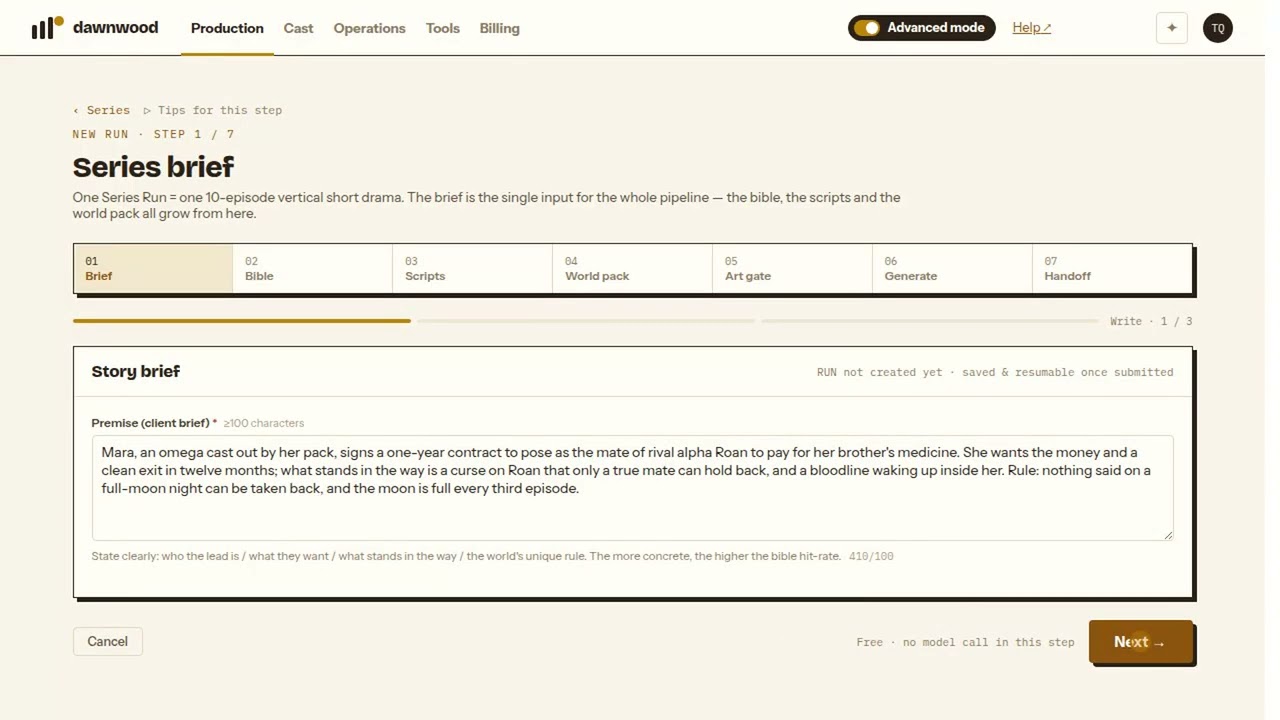
Paste your own manuscript as reference material in the brief; the season bible comes back with the engine and episode turns already laid out
Dawnwood's Auto mode turns a story told in a few lines into a vertical series. It writes the characters, the 10-episode outline and the scripts without spending credits, then films one episode at a time: you read the script and say go. Credits only go on art and filming, and each episode shows its cost before it starts.
Tell us your storyHow Auto mode works →