In shortDon't tell it in order. Decide first what stays true (the feeling, the choice, what it cost you), what you will dramatize (events, timing, who said what) and who gets renamed (everyone but you, unless they agree). Then cut what happened down to one engine: you, the one thing you wanted, the person or force in the way. Open on your worst day, not your childhood, and give every episode one turn. The hardest part is getting the inner story out of your head, which is why it helps to be interviewed rather than to face a blank page.

Your story is not a timeline
When people sit down to write what happened to them, they start at the beginning: where they grew up, how they met, how the company got its first customer. That is the order you lived it in. It is not the order anyone will watch it in.
A vertical drama gives you about a minute per episode and about thirty seconds to keep a stranger from swiping away. The question is not "what happened?" but "what did I want, who was in the way, and what did it cost me?" Everything you remember gets sorted against those three questions. What doesn't answer one of them, however much it mattered to you, is backstory.
Draw the truth line first
Before you write a single scene, decide three things, and write them down:
- What stays true. Usually the emotional core: what you felt, the decision you made, and what it cost. This is what viewers recognize as real, and it's the reason to tell your story instead of inventing one.
- What you will dramatize. Events get compressed, months become a scene, and three arguments become one. Conversations nobody recorded get written. A series built from real life is a dramatization, and saying so (in the description, or with a "based on a true story" line) is both honest and normal.
- Who gets renamed. Everyone except you, by default. Change names, jobs, and identifying details for anyone who hasn't agreed to appear. That protects them, it protects you, and it frees you to make the villain a villain without being unfair to a real person.
A real person who is recognizable and shown doing things they didn't do is where true-story projects get into trouble. Renaming and changing details is the simple fix. If your story involves a public figure, a lawsuit or anything you signed an agreement about, get proper legal advice before you publish. This guide is about craft, not law.
Find the engine in what happened
A season runs on one engine: one lead, one want, one obstacle, and one secret the viewer learns before the other characters do. Your life had several. Pick one.
"I started a company, it grew, my cofounder and I fell out, we shut it down" is a sequence of events. "A founder who promised her team she would never sell has to decide whether to save the company by betraying the partner who funded it" is an engine. It has a want (save the company), an obstacle (the partner, and her own promise) and a cost you can feel.
The same works for family stories ("a daughter who was blamed for her brother's accident finally learns who really drove that night"), comebacks, illnesses, migrations and second careers. Find the decision you're still thinking about years later. That's usually the center of the engine.
Open on your worst day
Most memoirs earn their big moment slowly. A vertical drama opens on it. Go through what happened and find the scene you would describe to a friend first: the meeting where the money disappeared, the phone call, the moment the door closed. That's episode 1, minute one. Everything that led up to it becomes backstory that you drip in later, a line at a time, once the viewer wants to know how you got there.
Then make the ending a choice, not a summary. Real life rarely ends on a cliffhanger, but each episode has to. Stop every minute at a point where your lead has to decide something, or has just learned something the viewer wants to see them act on.
Say it out loud
The thing that made your story hard to live was mostly inside your head: doubt, guilt, the speech you never gave. A vertical screen can only show a face and what it says. So every important thought has to become a line said to someone: the cofounder, the parent, the friend who told you so. If there was nobody to say it to, invent the scene where you finally do. That's what dramatized is for.
Get it out of your head first
The real difficulty with a personal story isn't structure. It's that the best material only comes out when someone asks the right question: what exactly did they say? where were you standing? what did you decide that night? Faced with an empty "describe your series" box, most people write a paragraph of summary and stop.
That's why Dawnwood starts personal stories with a free story interview instead of a blank box. It asks one question at a time (what happened, the hardest decision, who stood against you, who helped, the moment it turned, what viewers should walk away with), follows up on vivid details, and after about ten answers writes an editable series brief: lead, want, obstacle, characters, tone, and truth notes that record what's true, what's dramatized and who was renamed. You can answer in any language, skip questions, and edit or redraft the brief before it starts a season.
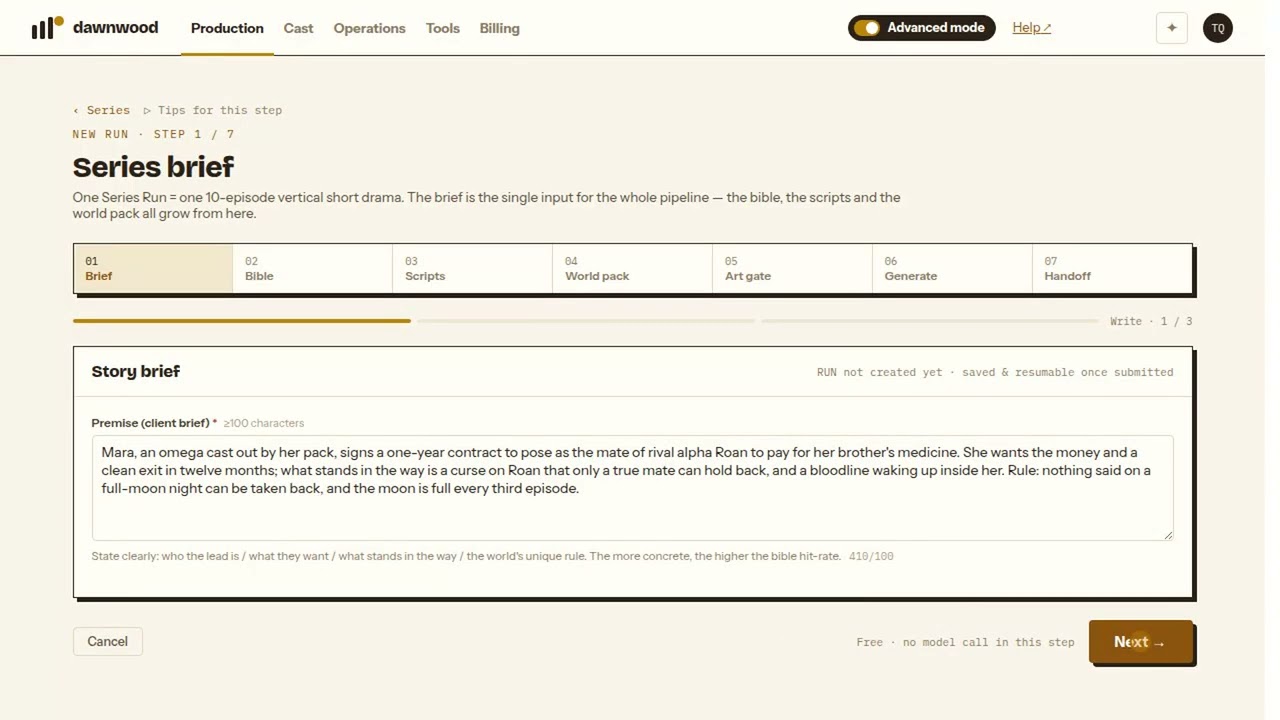
Answer about ten questions about what happened; the interviewer writes the series brief, with everyone else renamed
Dawnwood's story interview asks one question at a time and, after about ten answers, writes a series brief you can edit: the lead, what they want, who stands in the way, the characters and truth notes. The interview and the brief use no credits, and one click turns the brief into a season run.
Start your story interviewI already have a premise →