In shortBillionaire romance in vertical format runs on a wealth gap made visible in the first shot, a fixed cast web (the cold CEO, the underestimated heroine, the rival who has the status she lacks, the family that looks down on her) and one of five formulas: contract marriage, mistaken identity, the hidden child, the substitute bride, and the secret heiress. Every formula pays off in public: the people who humiliated her watch him choose her, or watch her turn out to outrank them.

Why the genre fits the format
Billionaire romance is the most produced setting in vertical drama because it gives a writer a status gap the camera can show in one frame (the penthouse and the rented room, the black card and the declined one) and a reveal that changes every relationship at once: the moment the room learns who he is, or who she really is. Both fit a 60–90 second episode, and both can be withheld for forty episodes.
The emotional frame is usually sweet healing (someone powerful chooses her without being asked), with a revenge line against the people who looked down on her. The healing line carries the middle; the revenge line owns the act endings.
The cast web
Five roles. Names and industries are yours; the functions are not.
The CEO. Head of a group, a dynasty or a family office; the most powerful person in any room he enters. Cold to everyone, and to her at first. His power has to be shown through other people's reactions (executives going silent, a deal cancelled with one call), not through him saying so. His coldness has a reason in the past, revealed late.
The heroine. Starts with nothing the room values: no money, no family name, or a family that uses her. Competent at something specific (design, medicine, cooking, a skill the plot will need), and proud. She does not chase him. Her arc is from enduring to choosing; by the end she sets the terms.
The rival. The woman with the status the heroine lacks: the childhood fiancée, the board member's daughter, the "proper" match. She is the source of the early humiliations and the misunderstandings. She is exposed in public, usually by evidence, and loses the thing she was sure of.
The family. His mother, grandfather or board who opposes the match; often her own family too, who sold, used or abandoned her. One elder is quietly on her side and is the first to recognise her worth.
The ex (optional). The man who left her for money or for the rival. Exists to see her on the CEO's arm and to regret. He is never taken back.
The five formulas
Each has the same skeleton: a public humiliation in episode 1, a power reveal in the middle, and a public reversal at the end.
- Contract marriage. He needs a wife on paper (an inheritance clause, a sick grandparent, a scandal to bury); she needs money for a debt or a hospital bill. Rules on day one: separate rooms, no feelings, divorce in a year. Every rule breaks in order. The finale is the contract torn up in front of the family that called her a gold-digger.
- Mistaken identity. She meets him as an ordinary man (a driver, an intern, a stranger on a bad night) and treats him decently while everyone else is rude to him. The reveal lands in a room where the people who mocked them both have to bow. Variant: she is the one hiding it.
- The hidden child. One night, she disappears, years pass. A gifted child with his face walks into his building or his life. He follows the resemblance home. Her family or the rival tries to use the child; the child takes the mother's side. Gives you a third character who can carry cliffhangers when the leads are apart.
- The substitute bride. Her sister, cousin or the rival was supposed to marry him and ran; she is sent in her place, expecting a monster. He turns out to be the only person who has ever seen her clearly. The runaway comes back to reclaim the marriage and finds the door closed.
- The secret heiress. She is treated as the poor relation, the adopted one, the girlfriend from nowhere. In the middle of the season it is revealed that she is the real heir of a family richer than his. Now the gap flips: the people who humiliated her, and sometimes his family, need her.
Formulas 1 and 4 are healing-led. Formulas 2 and 5 are reveal-led and suit seasons that want a revenge finale. Formula 3 runs longest without repeating itself.
The three-stage rhythm
- Open (first 3 seconds of episode 1): the gap and the insult in one image. A slap at an engagement party, a drink thrown, a card declined at the counter while he watches. See the first-thirty-seconds hook.
- Middle: proximity under a rule. Shared house, shared office, fake public appearances. He protects her before he admits anything; she refuses help she has not asked for. Each episode moves one step closer and adds one obstacle from outside (the rival, the family, the past).
- Close (every episode): a status beat. A reveal of who he is, who she is, what the rival did, or him choosing her in front of someone who doubted it. These map onto the five cliffhanger types.
Rules viewers enforce
- His wealth protects her; it never buys her. If money is what wins her, viewers turn on him.
- Her worth comes from who she is, not only from a bloodline reveal. If you use the secret-heiress formula, show her competence before the reveal.
- The conflict comes from outside the couple. They can misunderstand each other; they do not scheme against each other.
- Every humiliation is paid back in a scene of equal size, in front of the same audience.
- Keep the wealth specific and visual (the building, the car, the boardroom) and rationed. Spectacle every episode stops reading as power.
Worked example
The Alpha's Bought Bride takes the dynasty-and-arranged-match setting and turns it toward revenge: sold into a powerful family as an infant and kept compliant for twenty-seven years, socialite Celeste Vane cancels her arranged engagement and comes home to make the family pay. Episodes 1–5 are free on <a href="https://duskwire.ai/bought-bride/">duskwire.ai</a> if you want to see the cast web on screen.
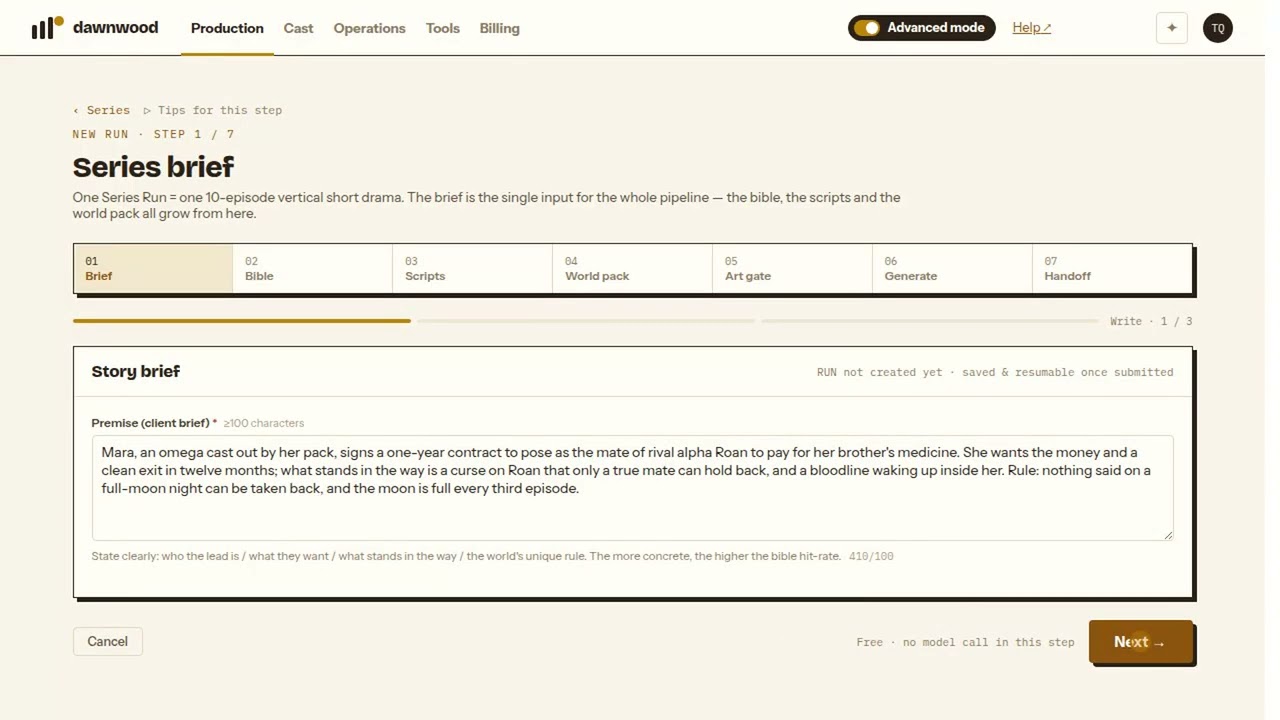
Tick "billionaire" and pick a formula in the brief; the season bible builds the cast web and the reveal ladder
Dawnwood's Auto mode turns a story told in a few lines into a vertical series. It writes the characters, the 10-episode outline and the scripts without spending credits, then films one episode at a time: you read the script and say go. Credits only go on art and filming, and each episode shows its cost before it starts.
Tell us your storyHow Auto mode works →