In shortHidden identity is the biggest male-lead genre in vertical drama. A man everyone looks down on (the live-in son-in-law, the security guard, the returning soldier, the delivery rider) is secretly the richest, strongest or most powerful person in the room, and the season is a ladder of moments where someone humiliates him and then finds out who he is. The cast is fixed (the hero, the wife or love interest who believed in him, her family, the rival who mocks him, and the people who know his real name), and the craft is in pacing the reveals so every episode pays one off without spending the big one too early.

Why the genre fits the format
Hidden identity is built out of the unit vertical drama is best at: an insult and its answer, inside a minute. Someone sneers, the hero takes it, and within a few beats a phone call, a bowing stranger or a black card turns the room around. Viewers know who he is from episode 1; the pleasure is watching everyone else find out, one person at a time.
That makes it revenge with the anger turned down and the satisfaction turned up. The hero rarely needs to plan anything. He only needs to stop hiding.
The cast web
Five roles. The city, the industry and the secret are yours; what each role does is fixed.
The hero. Underestimated on purpose. He has a reason to hide (a promise to a dying grandfather, a test of his wife's loyalty, an enemy who must not know he is back), and that reason is what keeps him quiet through episode after episode of insults. Calm is his signature: he never raises his voice, because he never has to.
The one who believed in him. His wife, fiancée or a single loyal friend who stood by him when he was nobody. Her faith is the moral centre of the season. Every reveal is also a reward for her, and the viewers want her vindicated as much as they want him revealed.
Her family. The mother-in-law who calls him useless at every dinner, the brother-in-law who borrows his money and his dignity. They are the recurring audience for the small reveals, and they never quite learn, which is what keeps them useful.
The rival. The rich suitor, the arrogant manager, the cousin who wants her or the company. He humiliates the hero in public, and his downfall is the season's biggest slap.
The ones who know. A butler, an old comrade, a secretary on the phone who says "Sir" in front of the wrong people. They are the reveal machinery: every time one of them appears, someone in the room gets closer to the truth.
The five formulas
The skeleton is the same in all five: he is humiliated in episode 1, he reveals a little in every episode, and in the finale he reveals everything in front of the people who mocked him most.
- The live-in son-in-law. Married into her family three years ago, treated as a servant, mocked at every gathering. The oldest and still the biggest version of the genre. The finale is the family begging the man they made wash the dishes.
- The returning soldier. He left as a nobody and comes back as a commander nobody at home has heard of. Formula of choice when you want action set pieces: his past arrives with him.
- The undercover heir. The richest family's son working an ordinary job to learn the business, or to find out who loves him without the money. Pairs naturally with billionaire romance when you want a female audience as well.
- The hidden master. A doctor, a fighter, an appraiser or a chef whose skill is far beyond anyone in the room. Reveals come through the skill itself (he saves the patient the specialists gave up on), so this formula needs fewer phone calls and more set pieces.
- The boss on the floor. He owns the company and works in it as a junior, a driver or a security guard. Every insult from a manager is a future firing. The easiest formula to write and the cheapest to shoot: one office, one lobby, one boardroom.
Formulas 1 and 3 lead with the relationship. Formulas 2 and 4 lead with set pieces. Formula 5 is the fastest to set up in episode 1.
The reveal ladder
The mistake most first seasons make is spending the big reveal early. Pace it as a ladder, where each rung is a bigger audience finding out:
- Rung 1: one person. A stranger recognises him and bows; the only witness is someone nobody believes. Episodes 1–5.
- Rung 2: the room. He settles a problem at a family dinner or an office meeting with one call. The family explains it away as luck. Episodes 6–15.
- Rung 3: the rival. The rival's deal, job or fortune turns out to depend on him. The rival knows; the family still doesn't. Mid-season.
- Rung 4: the family. Proof nobody can explain away. The mother-in-law's face is the episode. Two-thirds in.
- Rung 5: everyone. A public stage (a gala, a shareholder meeting, a wedding) where his real name is spoken out loud. The finale.
Each episode should climb or stay on a rung, never go back down. A paywall works best right after a rung-2 or rung-3 payoff, when the viewer has tasted it and wants the next one; see cliffhangers and payoffs.
Rules viewers enforce
- He is never cruel to the weak. His answers go to people who abused power over him, never down to someone below him.
- The one who believed in him is rewarded first and most. If the reveal helps him but leaves her behind, the season loses its heart.
- Every insult gets paid back, and on screen. An insult that is never answered reads as a dropped thread.
- The hiding needs a reason viewers accept. "He felt like it" breaks the genre; a promise, a test or a threat holds it up for 50 episodes.
- Keep the reveals specific. "He is rich" lands once; the bank manager running down the stairs, the license plate, the title on the door land again and again.
Generating it with AI video
The genre lives on reaction shots: the sneer, the call, the face that drains. Write each reveal as a sequence of faces rather than a speech, and keep the hero's costume deliberately plain until the finale so the change is visible in one frame. The shot-to-shot rules for keeping him recognisable while his clothes and status change are in character consistency across episodes.
Worked example
The Alpha's Bought Bride runs the same engine from the heroine's side: sold to a powerful family as an infant and kept compliant for twenty-seven years, Celeste Vane is the one the house has decided doesn't matter, and the season is that family learning, one public moment at a time, how wrong they were. Episodes 1–5 are free on <a href="https://duskwire.ai/bought-bride/">duskwire.ai</a>.
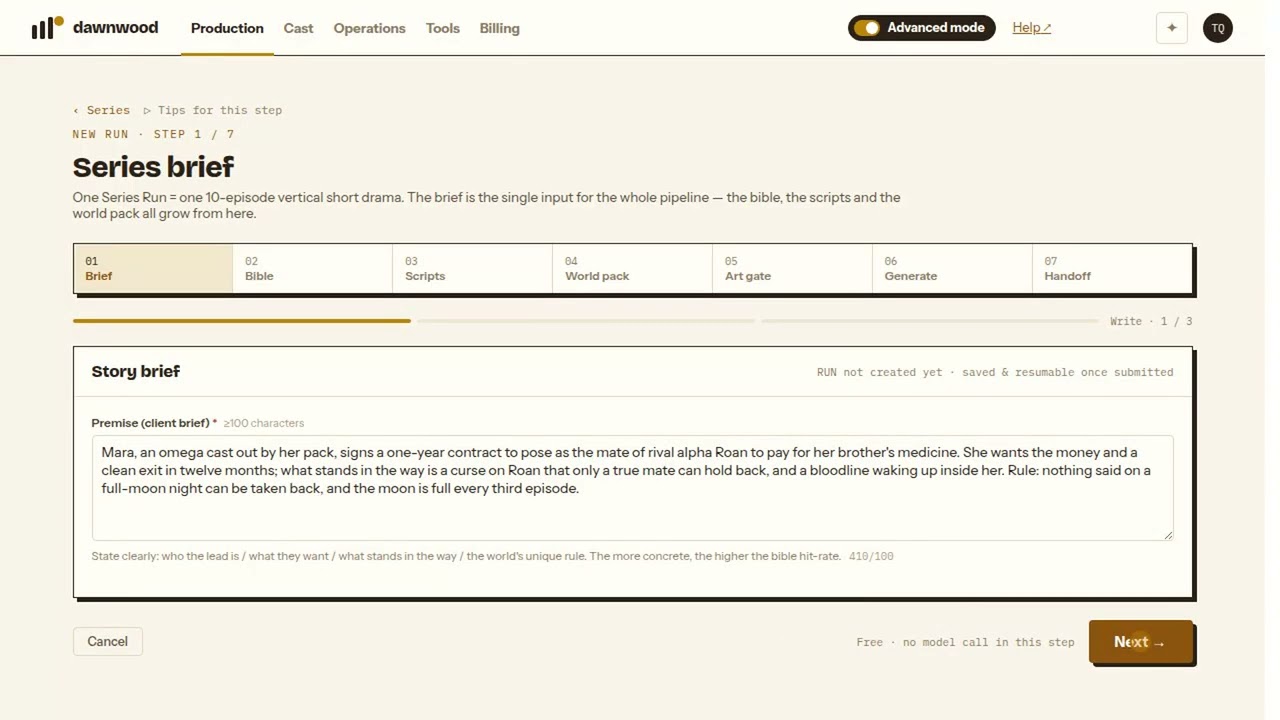
Tick "hidden identity" in the brief and pick a formula; the season bible lays out the reveal ladder episode by episode
Dawnwood's Auto mode turns a story told in a few lines into a vertical series. It writes the characters, the 10-episode outline and the scripts without spending credits, then films one episode at a time: you read the script and say go. Credits only go on art and filming, and each episode shows its cost before it starts.
Tell us your storyHow Auto mode works →